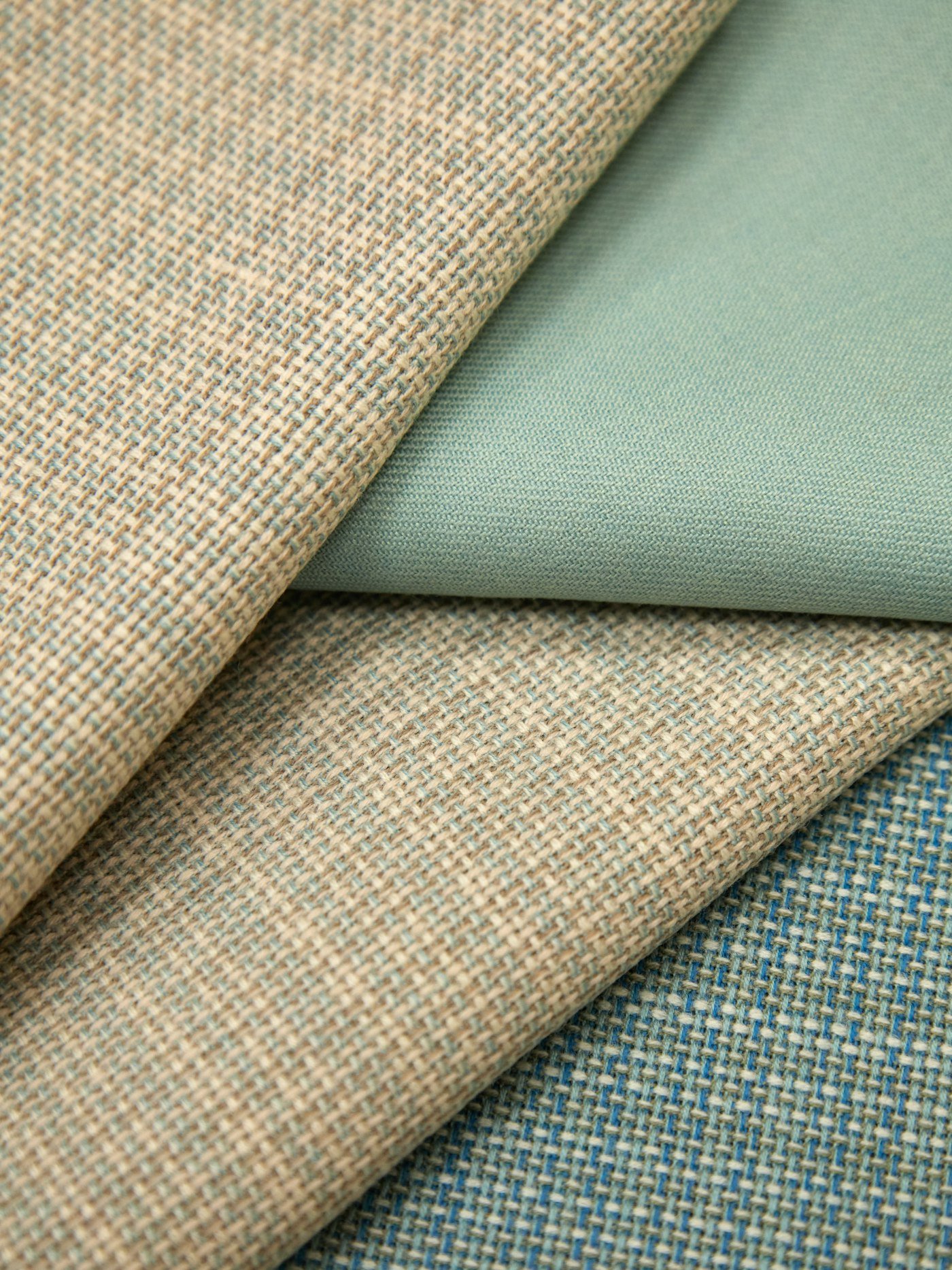
A fabric spec sheet looks like alphabet soup – ISO this, EN that, a rub count, a weight and a cleaning code. But every line answers a practical question: will it wear, will it fade, can I clean it, and how much do I need? Here’s how a working upholsterer reads one, line by line.
Composition
The fibre mix, e.g. “100% polyester” or “55% linen, 45% viscose”. This sets the baseline for everything else. Synthetics (polyester, acrylic, olefin, nylon) resist stains and fading; naturals (cotton, linen, wool) breathe and feel nicer but need more care. Blends try to get the best of both. A high viscose content means a soft, lustrous fabric that water-marks easily – fine for a bedroom chair, risky for the family sofa.
Width
Upholstery fabrics are usually 140–152 cm wide, with outdoor and some commercial fabrics up to 160 cm. Width matters twice: for metreage, and for whether a long panel (a sofa back, a headboard) fits across the roll without a seam. A fabric listed as “railroaded” has its pattern running along the roll rather than across, so long panels can be cut in one piece.
Weight
Given in grams per square metre (g/m²) or occasionally grams per linear metre. As a rough guide:
- Under 300 g/m² – light; curtains, cushions, decorative chairs
- 300–500 g/m² – standard upholstery weight; most sofa fabrics live here
- 500–800 g/m² – heavy; commercial weaves, some velvets and boucles
- Over 800 g/m² – vinyl, leather, heavy PVC
Heavier isn’t automatically tougher – a dense 350 g/m² polyester can outwear a loose 600 g/m² cotton – but it does tell you how the fabric will handle. Very heavy fabrics fight you on tight corners; very light ones show every lump in the padding.
Abrasion: the Martindale rub count
The most quoted spec, and the most misunderstood. The Martindale test rubs a sample against wool in a figure-eight until threads break or the appearance changes. The result is a number of cycles. The tiers used in NZ and Australia:
| Martindale | Suitable for |
|---|---|
| Under 15,000 | Decorative only – cushions, occasional chairs |
| 15,000–25,000 | Light domestic – bedroom chairs, formal lounges |
| 25,000–40,000 | General domestic – most family sofas |
| 40,000–60,000 | Heavy domestic – main sofa, kids, pets |
| 60,000–100,000 | Light commercial – cafés, offices, waiting rooms |
| 100,000+ | Severe commercial – healthcare, transport, hospitality |
Two cautions. First, the number is a threshold, not a lifespan: a 100,000-rub fabric isn’t twice as good as 50,000 on your sofa; both will outlast the foam. Second, some sheets quote Wyzenbeek (double rubs) instead – a US test with different numbers. 30,000 Wyzenbeek is roughly comparable to 40,000 Martindale, but the tests aren’t directly convertible, so compare like with like.
Pilling
Tested to ISO 12945 and graded 1–5, where 5 means no pilling. Anything below 4 will fuzz on the seat and arm fronts within a year. Boucles and chenilles are most prone; tight flat weaves and velvets least.
Colourfastness and lightfastness
Two separate things. Colourfastness to rubbing (ISO 105-X12) is graded 1–5 and tells you whether dye transfers onto clothing – important for dark fabrics. Lightfastness (ISO 105-B02) is graded 1–8 on the blue wool scale and tells you how fast the colour fades in sunlight. Grade 4 is the minimum for domestic upholstery in Europe; in NZ’s sun, we’d want 5 or better for any room with direct light, and 6+ for sunrooms. Solution-dyed fibres routinely score 7–8.
Cleaning codes
Four letters, printed on the label and usually on the product page:
- W – water-based cleaners only. The easiest to live with.
- S – solvent-based (dry) cleaners only. Water may leave rings.
- W-S – either water or solvent products.
- X – vacuum only; no liquid. Rare on modern upholstery.
Our care guide on cleaning fabric and leather furniture covers the method for each code.
Fire performance
Domestic furniture in NZ has no mandatory upholstery fire standard, but commercial work does. You’ll see AS/NZS 1530.3 (ignitability, flame spread, heat and smoke indices), AS/NZS 3837 (group numbers 1–4 for wall and ceiling linings, sometimes required for fixed seating) and AS/NZS 4088 for composite fabric-and-foam systems. If a spec sheet quotes only a British or Californian standard, it may not satisfy an NZ specifier. Trade readers can find more in our NZ fire ratings guide.
Seam slippage and tensile strength
Two specs you’ll see mostly on commercial sheets. Seam slippage (ISO 13936) measures how far the yarns pull apart at a stitched seam under load – a fabric can have a fine rub count and still gape at the seams on a tight-fitting cushion. Look for a figure of 3 mm or less at the stated load. Tensile strength (ISO 13934) tells you how much force the fabric takes before it tears; it matters for sling seats, pulled-tight box cushions and anything with deep buttoning where the fabric is under constant tension.
Pattern repeat and direction
A repeat – say “vertical 32 cm, horizontal 15 cm” – means every panel must be cut so the pattern lands in the same place. The bigger the repeat, the more fabric you waste matching it. Add roughly one repeat length per major panel. Nap or pile direction (velvet, corduroy, some boucles) works the same way: all panels cut running the same direction, which typically adds 10%.
Backing and finish
Look for terms like “acrylic backed” or “latex backed” (adds stability and stops fraying – good for loose weaves and boucles), “stain-resist finish” (a fluorocarbon or PFAS-free repellent that wears off over time) and “antimicrobial” (important for healthcare and marine).
Putting it together
For a family sofa in a bright NZ living room, a sensible spec reads something like: polyester or acrylic blend, 140 cm+, 350–500 g/m², 40,000+ Martindale, pilling 4+, lightfastness 5+, code W. For a formal chair, you can relax the rub count and lightfastness and pick for looks. Our complete NZ buyer’s guide walks through the decision room by room.
For commercial fit-outs, where the spec has to be documented for a project manager or a fire engineer, the numbers aren’t optional. If you’re in Auckland and the project needs a trade upholsterer who deals with specifiers daily, our sister workshop Upholstery World handles commercial upholstery and can advise on compliant fabric before you buy.
Every fabric we sell lists its specs. Compare width, weight, rub count and cleaning code side by side in our upholstery fabrics range, or order a sample pack and check the hand and colour in your own room. Everything ships nationwide from our workshop — courier to any New Zealand address, or click & collect.