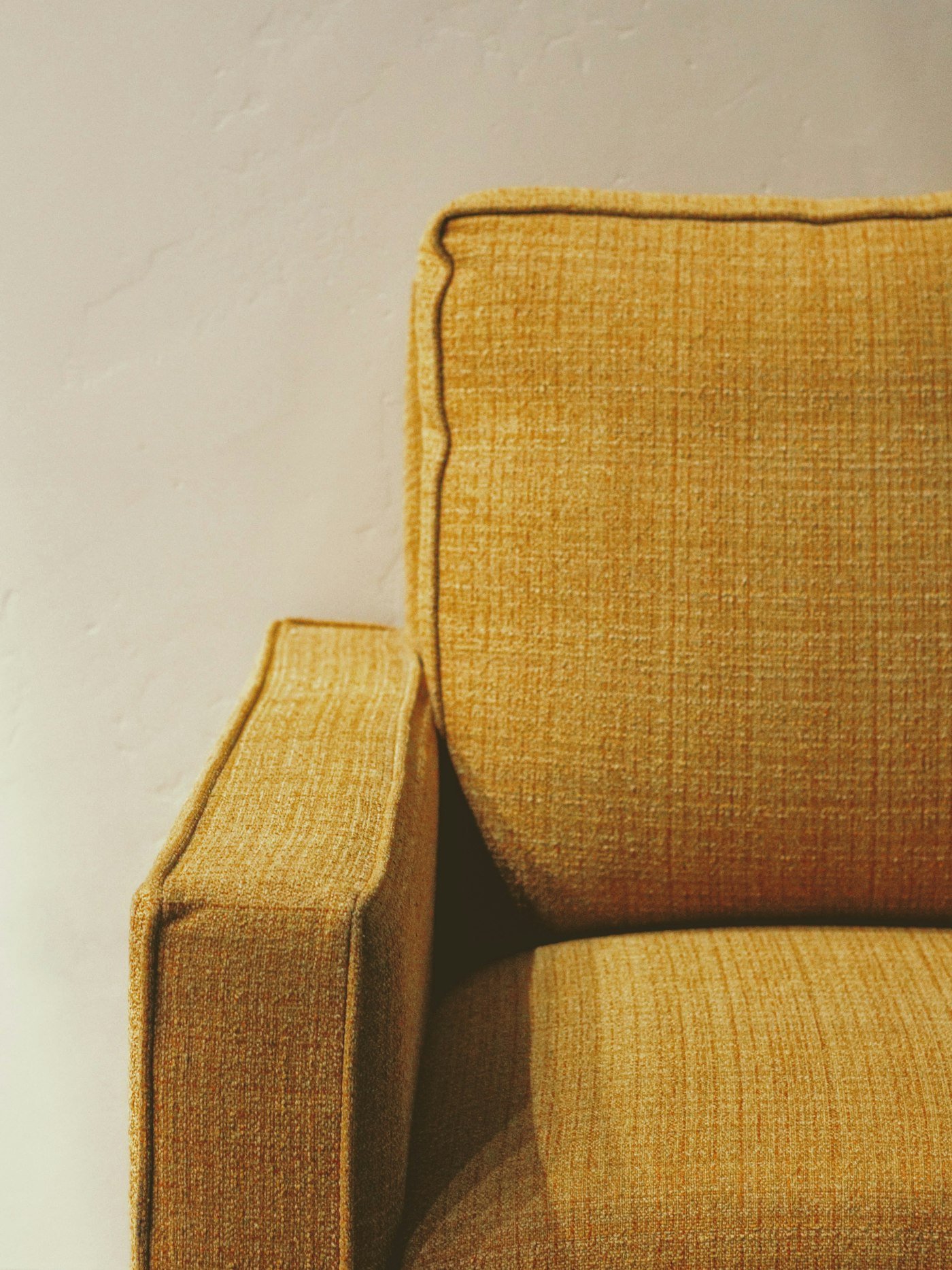
If your sofa still has a good frame and a cover you like, new cushion foam is the cheapest upgrade in furniture. The whole job is measuring correctly, choosing the right density and knowing what to add for the wrap. Here is exactly how we do it.
Step 1: Decide what you are replacing
Pull a cushion out and unzip it. You will usually find one of three things inside:
- Foam with a Dacron wrap – the most common. You replace the foam and usually the wrap.
- Foam core wrapped in feather/fibre “envelope” – common on higher-end sofas. Reuse the envelope if it’s in good shape, replace the core.
- Loose fibre or feather only – no foam. You can convert to a foam core for a firmer seat; measure the cover, not the stuffing.
If the foam has gone yellow, crumbly or has a permanent dent, it is finished. Foam that is simply softer than it was but still springs back can sometimes be rescued by adding a 25 mm firmer layer underneath, but for most 10-year-old cushions a full replacement is the right call.
Step 2: Measure the cover, not the old foam
Old foam has shrunk and collapsed, so measuring it gives you a cushion that is too small. Measure the empty cover instead, laid flat and zipped:
- Measure width seam to seam across the front.
- Measure depth front seam to back seam.
- Measure height of the boxing strip (the side panel) between the top and bottom seams.
- Note any shape: T-cushions, angled arms or curved fronts. Trace them on cardboard.
- Measure each cushion separately – they are often not identical.
Then add to the width and depth. Foam is cut oversize so it fills the cover under tension and the corners stay crisp:
| Cover dimension | Add for foam | Example |
|---|---|---|
| Width | +10 to +15 mm | Cover 600 mm → foam 610–615 mm |
| Depth | +10 to +15 mm | Cover 550 mm → foam 560–565 mm |
| Height (with Dacron wrap) | +0 to +5 mm | Cover 120 mm boxing → foam 120–125 mm |
| Height (no wrap, tight look) | +10 mm | Cover 120 mm → foam 130 mm |
Don’t overdo it. Foam that is 30 mm too wide bows the front and strains the zip. If you are unsure, order to cover size plus 10 mm and use the wrap to fill.
Step 3: Choose density and firmness
Density (kg/m³) tells you how long the foam will last; hardness tells you how it feels. They are not the same thing – a dense foam can be soft. For sofa seats in NZ homes:
- Seat cushions: high-resilience 35 kg/m³ (HR35) is the standard for daily use. It keeps its shape for 10+ years and has the springy feel people expect from a good sofa. Our HR35 seat foam sheet is the one we use in our own workshop.
- Back cushions: softer, lower density is fine (22–28 kg/m³) because they take little load, or use fibre-fill.
- Heavy use or larger people: HR35 in a firmer grade, or go 10 mm thicker rather than changing density.
We explain the numbers in Foam density and firmness explained. If you only remember one thing: for seats, don’t go below 30 kg/m³, whatever the price.
Step 4: Thickness and layering
Most NZ sofa seat cushions are 100–120 mm. HR35 comes in 25, 50, 75 and 100 mm sheets, so a 120 mm cushion is a 100 mm plus a 25 mm laminated together with spray adhesive – or, better, order it cut to size and we glue it for you. If you want a plusher top, laminate 25 mm of softer foam on top of 100 mm HR35 rather than dropping the whole cushion to a softer grade.
Step 5: Add the Dacron wrap
A Dacron (polyester wadding) wrap does three things: it rounds the edges, it fills the cover so the foam doesn’t show through as a hard box, and it lets the cover slide on. Use 200 gsm for standard cushions. Wrap it over the top, front and bottom of the foam (not the sides, or the boxing bulges), and hold it with a light mist of spray adhesive. Our 200 gsm Dacron wrap comes by the metre; one metre covers about two 600 × 600 mm cushions.
Step 6: Getting the foam into the cover
This is where people give up. The trick is a plastic bag or a length of thin builder’s film. Wrap the foam in film, slide the whole thing into the cover, then pull the film out through the zip opening. The foam expands into the corners and the cover lands exactly where it should. Never force wrapped foam in dry – the Dacron bunches and you get lumps.
Back cushions and bolsters
Back cushions rarely need HR foam. If they have collapsed, the quickest fix is to top up the fibre-fill through the zip – around 200–300 g per cushion – and plump. If they were foam originally and have gone soft, replace with a 22–28 kg/m³ soft foam at the same thickness and wrap in 300 gsm Dacron for extra loft. Bolsters and arm cushions are usually a rolled foam core; measure the circumference of the empty cover, divide by 3.14 for the diameter, and subtract 10 mm.
Ordering checklist
- Length × width × thickness in mm for each cushion (foam size, not cover size)
- Shape template for anything not rectangular
- Density: HR35 for seats
- Number of cushions
- Metres of 200 gsm Dacron: roughly 0.5 m per cushion
- Spray adhesive if laminating layers
Send the list through our contact page for a cut-to-size quote. Foam ships NZ-wide; it compresses well so freight is usually less than people expect.
When replacement foam won’t fix it
If the cushions were fine but the sofa sags, the problem is underneath: stretched webbing or tired springs. New foam on a collapsed base just sinks with it – see How to fix a sagging sofa. And if the cover has gone too, or the cushions are attached to the frame, Auckland readers can hand the whole thing to our sister workshop Upholstery World, who replace foam and re-cover on-site.
Shop it: Order HR35 seat foam cut to size and wrap it in 200 gsm Dacron. Browse the full foam & padding range.